Kairo Autos
Luxury automobile showcase and inventory platform with filterable stock and enquiry routing.
- Client
- Kairo Autos — luxury automobile dealer
- Role
- Web developer & UI/UX designer
- Timeline
- 4 weeks
- Year
- 2026
Device · 390 × 844Idle
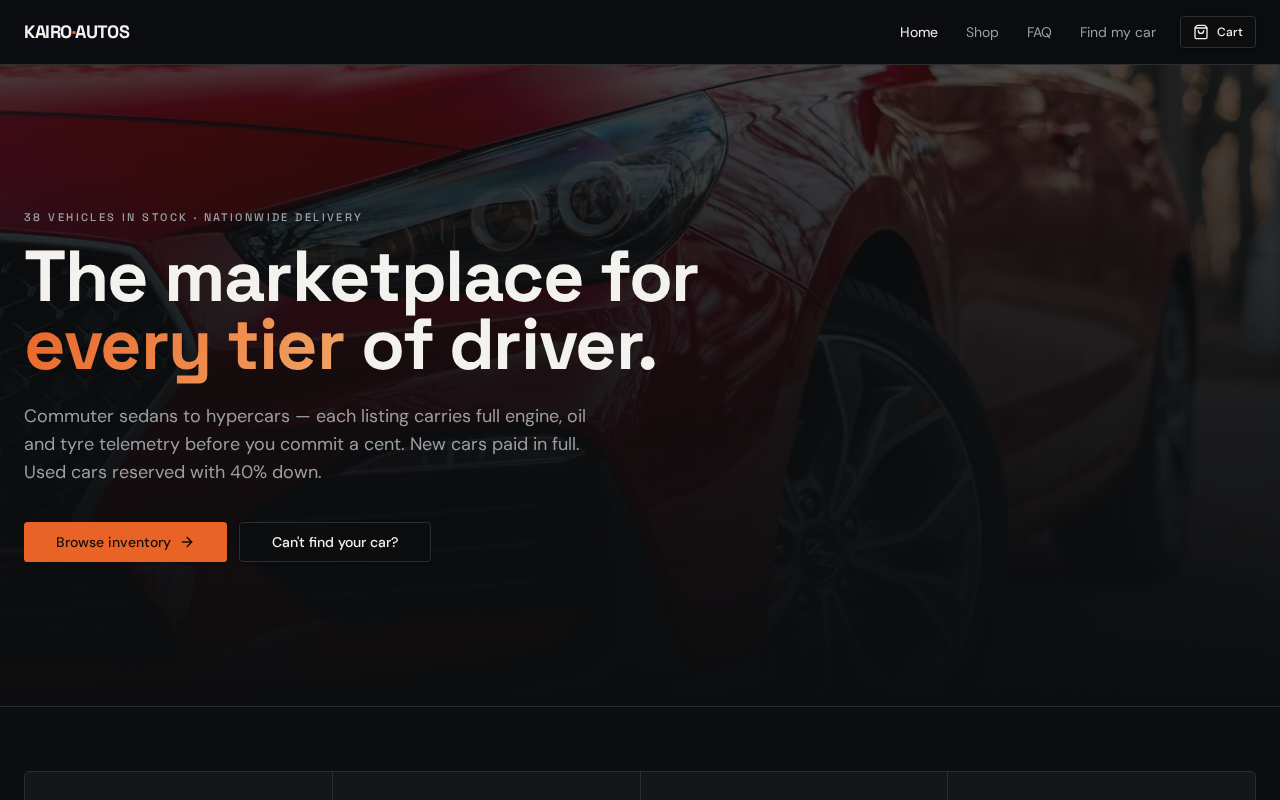
Kairo Autos — responsive buildOpen ↗
Some hosts block embedding. If the frame stays blank, open the site directly.
01
Overview
A high-end automotive showcase where each vehicle is a full listing — gallery, spec table, mileage, drivetrain and price — backed by an inventory model that lets the dealer add or retire stock without touching layout code.
02
The problem
Stock was being advertised across social posts and a spreadsheet. Buyers could not compare vehicles, specs were inconsistent between posts, and every serious enquiry arrived without knowing which car it referred to.
03
Approach
- 01Modelled the inventory as typed vehicle records: make, model, year, mileage, transmission, price band and gallery.
- 02Built a filterable listing grid (price, body type, year) with the filter state reflected in the UI so the dealer can share a view.
- 03Designed a cinematic detail page: full-bleed hero image, spec table in monospace, and an enquiry CTA bound to the specific vehicle.
- 04Optimised the galleries with responsive sizing and lazy loading so a 20-image listing still opens instantly on mobile data.
04
Strategy & UX decisions
- A dealer's inventory is scanned, not read — so the grid uses a wide image ratio with price and mileage locked to a fixed position, letting a buyer compare five cars in one glance.
- Spec data is set in monospace so numbers align column-to-column; the buyer's eye can run down the sheet instead of hunting for the figure.
- The enquiry CTA is bound to the vehicle record and repeats after the gallery, because high-ticket intent forms at the bottom of the page, not the top.
05
Challenges
- Large automotive photography versus mobile performance — resolved with aspect-ratio boxes, compression and deferred loading.
- Spec fields differ per vehicle; the spec table had to render gracefully with missing values instead of empty rows.
- Keeping a luxury visual tone while still surfacing price and availability clearly above the fold.
06
Learnings
- →In high-ticket sales the detail page is the whole product — the listing grid only needs to get people there.
- →Typed inventory records turn 'add a new car' into a data edit, which is what a dealer can actually maintain.
- →Enquiries that carry the vehicle context convert far better than a generic contact form.
07
Tech & tooling
- React
- TypeScript
- Tailwind CSS
- Typed inventory model
- Filtered listings
- Responsive galleries
08
Outcome
- Full inventory browsable and comparable on mobile.
- Every enquiry arrives tied to a specific vehicle and price.
- Dealer updates stock in minutes with no developer involvement.
Next case study · Ref 002
TwoFourSeven