midejewelries
Custom jewelry platform with a filtered inventory archive and enquiry-led conversion.
- Client
- Mide Jewelries — luxury retail
- Role
- Web developer & UI/UX designer
- Timeline
- 4 weeks
- Year
- 2024
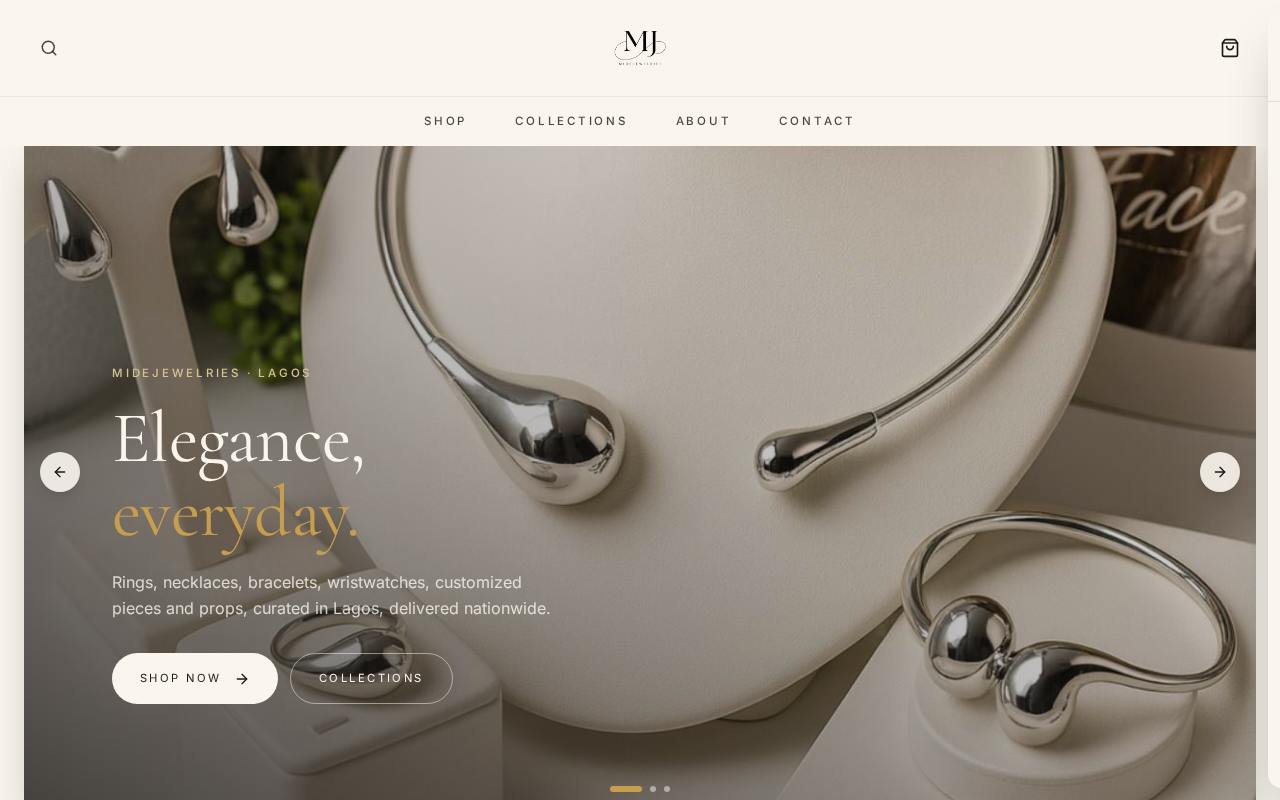
Device · 390 × 844Idle
midejewelries — responsive buildOpen ↗
Some hosts block embedding. If the frame stays blank, open the site directly.
01
Overview
A luxury jewelry storefront doubling as an inventory archive: structured product arrays, real-time pricing, filtered grid browsing and lead capture built for buyers who expect a consultation rather than a checkout button.
02
The problem
Luxury buyers rarely convert on a first visit, and inventory changes constantly as pieces sell or get commissioned. A static catalog would be stale within a week and would lose every high-intent enquiry.
03
Approach
- 01Built product data as structured arrays with material, stone, collection and price fields so filtering is derived, not hand-maintained.
- 02Real-time pricing so a change propagates to grid, detail view and enquiry payload at once.
- 03Editorial grid layout with generous whitespace and large imagery to match the price point.
- 04Inventory filtering by category, material and price band, with shareable result states.
- 05Lead capture attached to every product so an enquiry carries the exact piece and price.
04
Strategy & UX decisions
- Editorial grid with heavy negative space to match the price point — luxury buyers read restraint as credibility.
- Filter state is derived from structured product data and shareable by URL, so the client can send a curated selection.
- The CTA is a consultation, not a cart: enquiry capture is attached to every piece with its exact price.
05
Challenges
- Multi-dimensional filtering slowed as the archive grew; memoised derived lists and indexed by category.
- Balancing luxury restraint with commerce clarity — early layouts hid the price and the enquiry action.
- Keeping the private inventory archive and the public storefront on one source of truth.
06
Learnings
- →In luxury retail the CTA is a conversation, not a cart.
- →URL-shareable filter state is worth building from day one; clients send filtered views to buyers constantly.
- →One canonical product array removes an entire category of sync bugs.
07
Tech & tooling
- React
- TypeScript
- Tailwind CSS
- Filtered inventory model
- Lead capture forms
- Custom domain
08
Outcome
- Buyers browse an always-current archive instead of a PDF lookbook.
- Every enquiry arrives with product and price context attached.
- Inventory updates take minutes, not a redesign cycle.
Next case study · Ref 006
Bunkeh Vic NGO